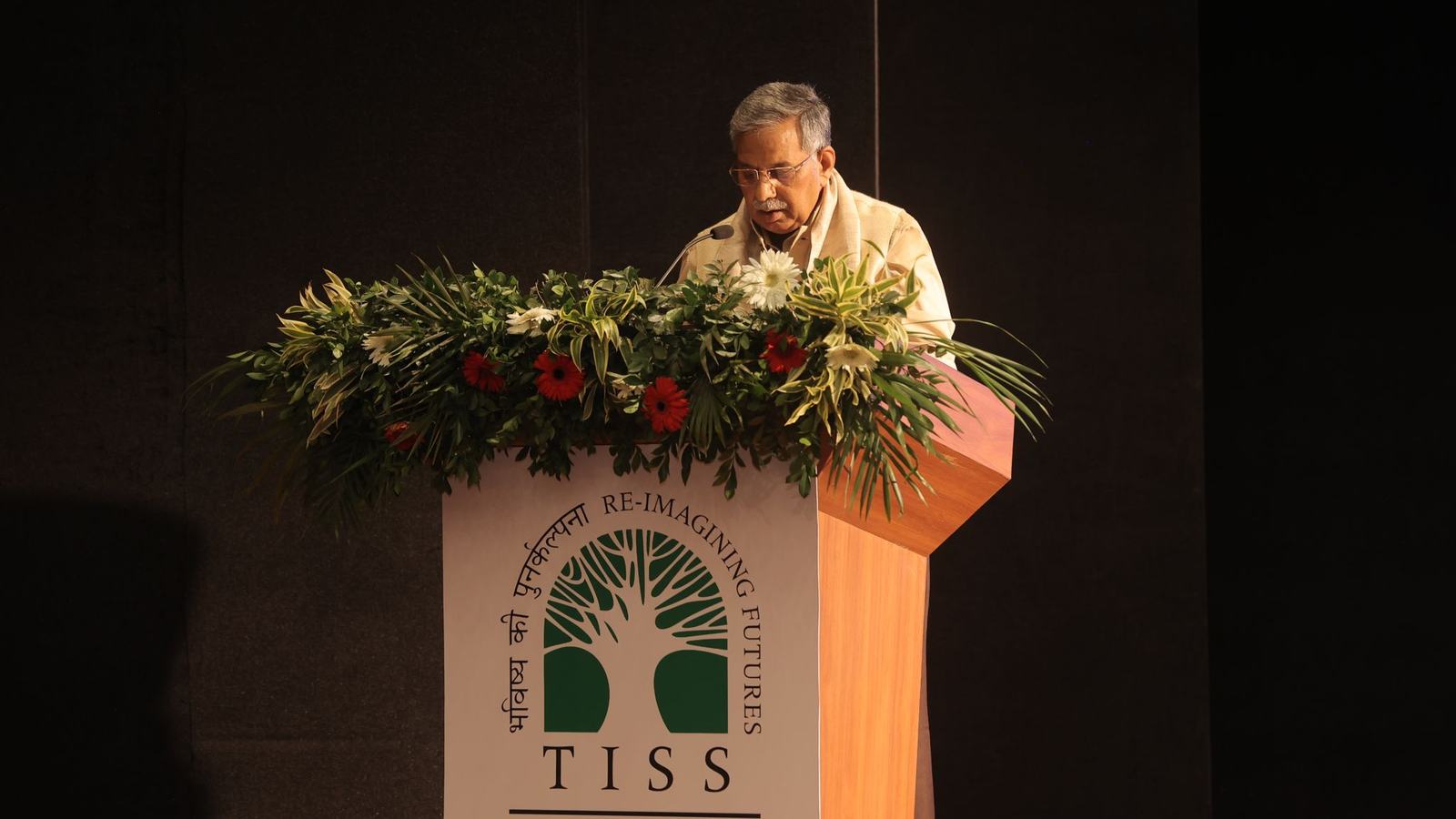
Presidential Address delivered by the TISS Chancellor, Prof. D.P. Singh at the 12th Convocation of TISS Guwahati
Hon’ble Chief Guest, Justice Soumitra Saikia, Gauhati High Court; Vice Chancellor of TISS, Prof. Badri Narayan Tiwari; Campus Director, Prof. Jagannath Ambagudia; Officiating Registrar, Dr. Narendra Mishra; Dean…
Hon’ble Chief Guest, Justice Soumitra Saikia, Gauhati High Court; Vice Chancellor of TISS, Prof. Badri Narayan Tiwari; Campus Director, Prof. Jagannath Ambagudia; Officiating Registrar, Dr. Narendra Mishra; Dean Academic Affairs, Dr. Sunil Santha; Dean, School of Social Work, Prof. Kalpana Sarathy; distinguished members of the Advisory Committee; esteemed faculty, staff, and guests; and most importantly, the graduating students and their proud families:
A convocation is a threshold. On one side lies the discipline of learning; on the other, the demands of a life in service. Today you cross it. My warmest congratulations to each of you.
You cross it from a campus that carries unusual meaning. TISS turns ninety this year - nine decades of scholarship in the service of society, of insisting that knowledge must be answerable to real lives and real communities. The Guwahati campus is the expression of that conviction in one of India’s most culturally layered, ecologically rich, and historically significant regions. The Northeast has long awaited the depth of academic attention it deserves. TISS Guwahati exists to close that gap: to be an intellectual and social bridge between the communities of this region and the larger national ambition of inclusive, equitable development. That is not a modest purpose, and it did not arrive without a tradition behind it.
The National Education Policy 2020 gives this purpose a national framework. At its core, NEP 2020 asks one question: what is education for? Its answer is the formation of thoughtful, grounded, and capable Indian as well as global citizens - not the mere conferral of credentials. TISS has always believed this. For the Northeast, NEP’s insistence on honouring local and indigenous knowledge and rooting learning in community engagement is long overdue. It recognises what this region has always known: that knowledge lives in people and in places, not only in textbooks. TISS Guwahati embraced the NEP framework from 2022, because the policy and the institution’s own convictions were already pointing in the same direction.
That direction converges with the national vision of @Viksit Bharat 2047 - a developed, self-reliant, and equitable India, built not through economic growth alone but through educational depth, social justice, and institutional strength. For this vision to be real rather than rhetorical, every region must be part of it - and not as a beneficiary but as a contributor. The graduates of TISS Guwahati, trained in social sciences and social work, grounded in fieldwork, equipped to work in communities, in governance, in public health, in livelihoods and policy - you are the human architecture through which Viksit Bharat becomes concrete. Not in some distant future, but in the choices you make in the years immediately ahead.
This brings me to what I most want to say to you today - about how you will actually live your professional lives. The world you enter measures success in familiar terms: position, output, recognition, advancement. These are not without value. But if you look carefully at the professionals and institutions that have endured - that have made a lasting difference rather than a brief impression - you will find that their durability rests on something that never appears on a resume or a performance dashboard. It rests on character. On the quality of how they worked, not only on what they produced.
Ravi Sharma, a former CEO and the founder of the Institute of Goodness, expresses this with unusual clarity. He asks: if happiness drives performance, what drives happiness? His answer is goodness - and he is careful to define it precisely. Goodness, he argues, is not a sentiment or a soft ideal. It is structural: the invisible infrastructure upon which everything else is built. When you operate with integrity, you eliminate the friction of hidden agendas and broken trust and redirect that energy toward creation. When you practice self-awareness and humility, you build the resilience to sustain performance under pressure without being consumed by it. When you contribute beyond yourself - what our own tradition calls Lok Kalyan - you find the kind of meaning that no title or salary alone can provide.
The Institute of Goodness distils this into six principles for professional life:
• Be fair and be kind - not as personality, but as discipline. Trust is built in small daily acts. It is the most durable thing you will ever create.
• Hold to integrity when compromise arrives - and it will arrive, quietly, dressed as the sensible thing to do. The professionals who endure are those who saw that moment clearly and held their ground.
• Take responsibility not only for your output but for your consequence - for the communities your work touches, not only the organisation that employs you.
• Respect the institutions and systems that enable collective life. Reform what is unjust - but weakening institutions without rebuilding them harms most those who depend on them most.